
The Research
The research is still growing.

We don't believe you should have to choose between hope and honesty.
There is promising research surrounding neurofeedback, brain regulation, and neuroplasticity. At the same time, not every claim made about neurofeedback has the same level of scientific support.
That's why we're committed to:
Following the research.
Being honest about what we know.
Being honest about what we don't.
And keeping the person—not the technology—at the center.
The Science
Technology designed to support nervous system recovery
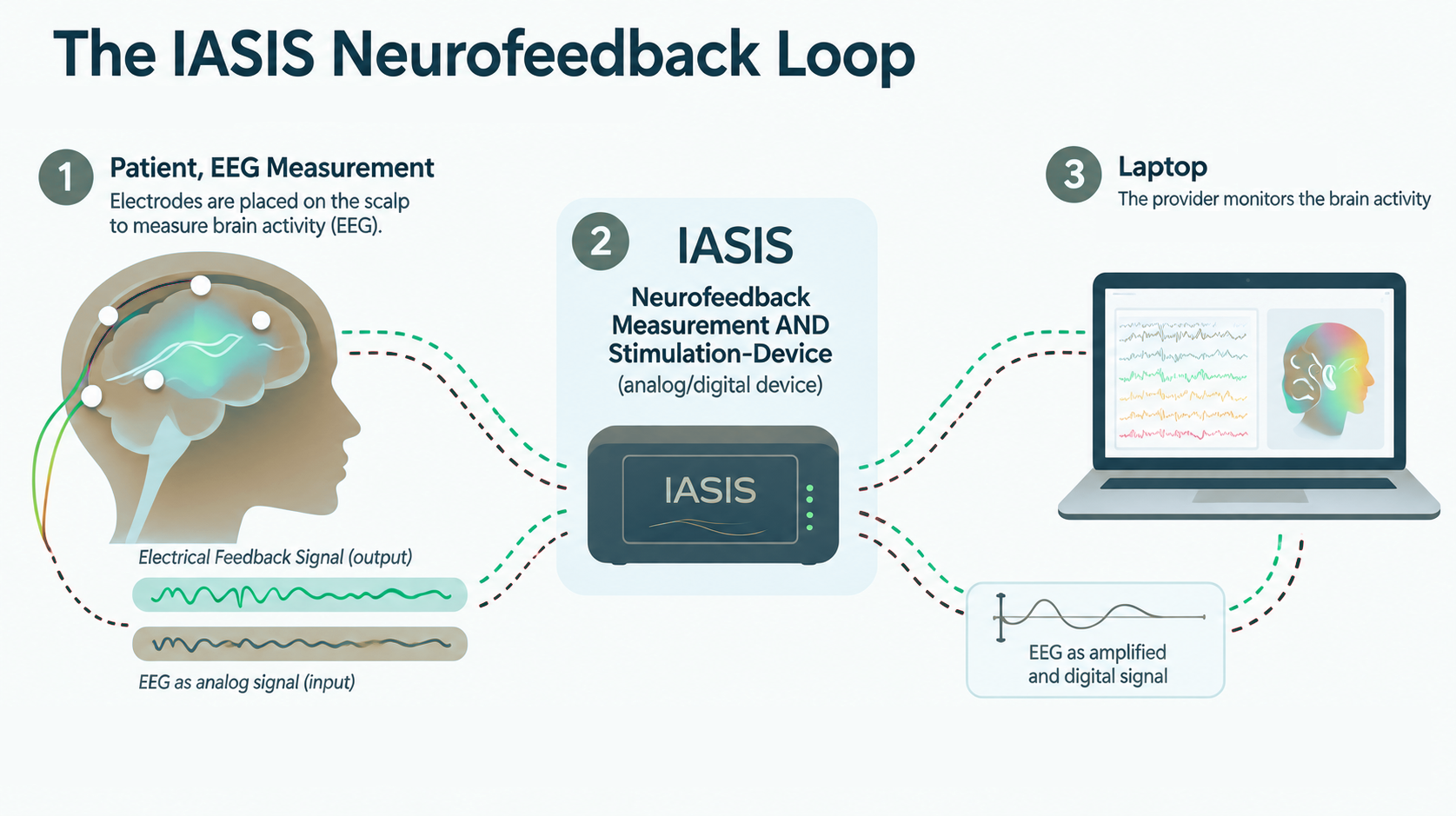
In simple terms:The brain sends information to the system, the system responds, and the brain receives that feedback. This ongoing exchange is designed to support the brain’s natural ability to regulate, adapt, and reorganize its patterns of activity.
Neurofeedback targets key communication networks in the brain.

Your brain is made up of connected networks that work together to help you think, focus, regulate emotions, respond to stress, and process information. The electrodes are placed at specific locations on the scalp that correspond with regions involved in three important brain networks:
Salience Network (SN), which helps the brain detect what matters and shift between different states of attention;
Central Executive Network (CEN), which supports focus, decision-making, problem-solving, and emotional control;
Default Mode Network (DMN), which is involved in memory, self-reflection, and processing internal thoughts.
These networks are constantly communicating with one another, and healthy brain function depends in part on their ability to coordinate and shift appropriately. During an IASIS session, the electrodes provide the brain with subtle feedback intended to support more organized patterns of communication and regulation across these networks.
The goal isn't to control the brain or force a particular response—it is to give the brain information and allow it to do what it naturally does best: adapt and reorganize.
“We’d love to help you learn more. Contact Healthy Minds with your questions, talk through what you’re looking for, and get current pricing and scheduling information.”
-- April, Erin, and Angie at Healthy Minds Neurofeedback